
Industrial HMI platform
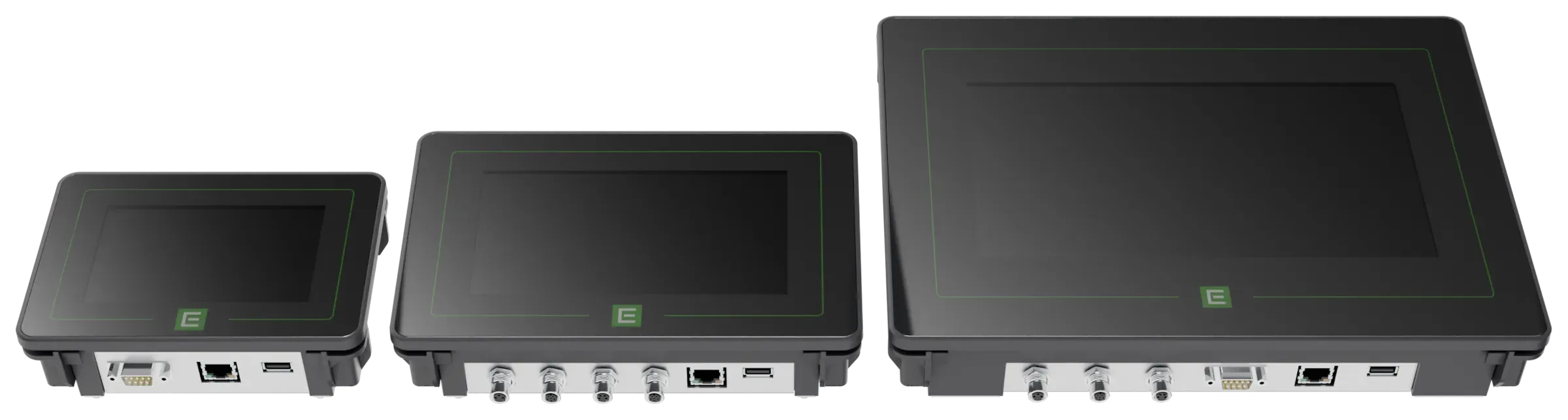
A display, control and data acquisition platform built around an Arm® Cortex®-M7 microcontroller: a complete embedded HMI on a modular hardware and software base, designed for harsh industrial environments, that adapts to each application.
Designed and developed in France by EMBELEC.

Key points
Arm® Cortex®-M7 core
Powerful, with a built-in hardware graphics accelerator
Touchscreen
5, 7 or 10 inches. Capacitive panel in tempered glass, or resistive for use with gloves.
TouchGFX graphical interface
Smooth animations and refined graphics, accelerated by the microcontroller’s hardware.
Industrial 12 / 24 VDC supply
Reverse-polarity and transient overvoltage protection, replaceable rated fuse.
Full fieldbus connectivity
Isolated 10/100 Ethernet, CAN bus, RS-485 and RS-232 links. Digital I/O, high-speed counting for incremental encoders, 4-20 mA and 0-10 V analogue.
Secure boot
Cryptographically signed firmware, with integrity checked on every update.
Applications
Machine control and supervision panel
Operating and monitoring machinery, in a cabinet, on a console or on an articulated arm.
Configuration and diagnostics terminal
Setting up equipment, reading measurements, exporting logs to a USB stick.
Display embedded in existing equipment
Compact panel-mount format that fits without reworking the host mechanics.
Specifications
Processing and display
- Microcontroller
- High-frequency Arm® Cortex®-M7, built-in hardware graphics accelerator
- Operating system
- Real-time OS (FreeRTOS or Eclipse ThreadX, formerly Azure RTOS), guaranteed timing determinism
- Graphics library
- TouchGFX, hardware-accelerated
- Screen sizes
- 5, 7 or 10-inch touch panels Other screen sizes and shapes available
- Touch technology
- Capacitive in tempered glass Resistive for use with gloves
Power supply
- Supply voltage
- Industrial 12 / 24 VDC range Mains supply also possible
- Protection
- Reverse polarity, transient overvoltage
- Fuse
- Rated and replaceable
Network connectivity
- Ethernet
- 10/100 Mbit/s, RJ45 with integrated magnetics Galvanic isolation
- Protocols
- TCP/IP, as both server and client IP address: DHCP or static address Encryption: TLS with server certificate verification
- Fieldbus
- CAN bus RS-485 and RS-232, isolated or protected
- USB host port
- Reading configuration files Writing logs Local software updates
Inputs and outputs
- Digital I/O
- Logic inputs and outputs Commands, indicators, basic safety
- High-speed counting
- Direct connection of incremental encoders Speed, positioning
- Analogue
- Industrial 4-20 mA and/or 0-10 V Pressure, temperature, level
- Reinforced galvanic isolation
- Optional, on analogue and counting I/O, for electrically noisy environments
Mechanical
- Enclosure
- Industrial, designed to withstand shock, vibration and dust
- Front panel
- Sealed, IP65 depending on mounting Built-in buttons and LEDs
- Mounting
- Panel, console or articulated arm
Cybersecurity
- Cyber Resilience Act
- Designed from the outset for compliance with the European regulation
- Secure boot
- Cryptographic signature No unauthorised code can be executed
- Updates
- Firmware integrity verified, via USB stick or encrypted Ethernet
What sets this platform apart
A base, not a fixed product
Screen size, touch technology, I/O and reinforced isolation are all configuration choices. Developing new equipment means starting from a proven platform rather than a blank sheet — and the time saved shows up directly in time to market.
Built for the factory floor, not the office
An enclosure that withstands shock, vibration and dust, a sealed front panel, a 12/24 VDC supply protected against reverse polarity and overvoltage, isolated serial links. The constraints of a factory environment are handled in the design, not worked around at installation.
An interface that does not look like an industrial screen
The microcontroller’s graphics accelerator and the TouchGFX library deliver smooth animations and refined graphics on a microcontroller rather than an embedded computer. You get the responsiveness of a modern embedded HMI with the determinism and reliability of a real-time system.
Cybersecurity handled from the design stage
Secure boot through cryptographic signature, integrity verified on every update: European cybersecurity requirements for connected industrial devices are addressed from the outset rather than bolted on afterwards.
The graphical interface
Operation
The plant diagram, the state of every device and the current readings on a single screen. The operator sees what the machine is doing without having to read a number.
Trends
The history of the readings, two quantities overlaid with a scale of their own. Enough to understand a drift rather than merely notice it.
Alarms
Time-stamped events, their severity and their state. The operator acknowledges what they have seen, and the record remains.
Mock-ups drawn to illustrate the kind of interface developed on this platform. They do not reproduce any customer project, and the values shown are fictitious.
An embedded electronics project?
Tell us what you need and we will talk it through together.
Get in touch